
El Periquillo Sarniento: The First Great Novel of the Americas (A Remarkable 1842 Discovery)
- Marie
- Apr 12
- 4 min read





Some books change the course of a nation’s literature. This is one of them.
El Periquillo Sarniento by José Joaquín Fernández de Lizardi is widely regarded as the first true novel of the Americas. Written in 1816 under Spanish colonial rule, censorship, and the shadow of the Inquisition, it used satire and storytelling to do something quietly radical: speak directly to the people.
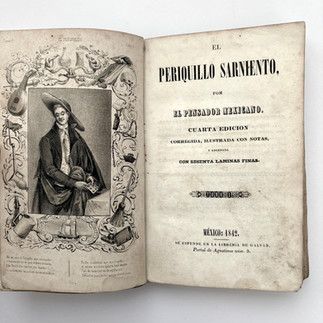
The copy I have handled is an 1842 illustrated Mexican edition. It is not just a book. It is a piece of literary and cultural history.
El Periquillo Sarniento and the First Novel of the Americas
When discussing El Periquillo Sarniento, it is difficult to overstate its importance. Often described as the first novel of the Americas, it marks a turning point between colonial literary traditions and the emergence of a distinctly Mexican voice.
Lizardi, writing under the pseudonym El Pensador Mexicano, combined humour, moral instruction, and sharp social observation. His central character, Periquillo, is not a hero in the traditional sense. He is flawed, impulsive, and frequently misguided. It is precisely through these failings that the reader is invited to learn.
This was literature with purpose. It entertained, certainly, but it also educated and challenged. In a period when open criticism could be dangerous, satire became a powerful and necessary tool.
A Book Written Under Censorship
The novel first appeared in 1816, at a time when Mexico was still under Spanish colonial control. Publishing was heavily restricted, and the influence of the Inquisition meant that writers had to tread carefully.
Lizardi’s solution was subtle but effective. By embedding social critique within narrative and humour, he created a work that could pass through censorship while still engaging directly with the realities of everyday life.
The result is a book that feels immediate, human, and surprisingly modern in tone.
The 1842 Illustrated Edition of El Periquillo Sarniento
The copy I have handled is Tomo I (Volume I) only, a reminder that multi-volume works of this period often survive in incomplete form.
The 1842 edition represents an important moment in the book’s history. By this time, the novel had already established its place within Mexican literature, and this edition expands upon it both visually and textually.
This is the cuarta edición corregida e ilustrada, printed in Mexico and adorned with engraved plates. It includes:
Two title pages, each with its own distinct character
Engraved frontispieces, including a striking symbolic scene of gambling and vice
A series of finely executed plates accompanying the text
Additional notes that deepen the reader’s understanding
The illustrations are not merely decorative. They interpret the narrative, reinforcing its moral and social themes. In this sense, the book becomes a dialogue between text and image.
Reading the Illustrations: Visual Storytelling in Print
One of the most compelling aspects of this edition is its visual language.
In one engraved scene, Periquillo is shown gambling, surrounded by objects that symbolise temptation and moral danger. In another, he appears as a more reflective, learned figure, holding a book. These contrasts mirror the arc of the narrative itself.
Illustration in early nineteenth-century Mexican printing was not commonplace, particularly at this level of execution. That this edition includes multiple engraved plates makes it all the more remarkable.
It is visual storytelling in the service of social commentary.
A Book That Was Read, Used, and Kept
What I find most compelling about this particular copy is not just what it is, but what it has been through.
Bound in full calf, the binding shows honest wear. There is rubbing to the spine, marks to the boards, and signs of handling that speak of use rather than neglect. Inside, the text block shows uniform age toning, with occasional marks and small imperfections consistent with a book of this period.
There is also a handwritten inscription dated 1850, naming an early owner, “Ignacio Villegas.” This is where the book moves beyond being an object and becomes something more personal.
Books like this were not ornaments. They were read, discussed, and passed from hand to hand.
Provenance and Survival
Like many books of its age, this copy is not entirely complete. A small number of plates and leaves are absent, and there are areas of wear and repair.
In modern collecting, there can be a tendency to focus only on perfection. But with early material, survival in any form is significant. The presence of original binding, contemporary inscriptions, and surviving engraved plates all contribute to its value as a historical artefact.
Each mark, each imperfection, forms part of its story.
Why El Periquillo Sarniento Still Matters Today
More than two centuries after it was first written, El Periquillo Sarniento continues to resonate.
It is a work rooted in its time, yet concerned with universal themes: morality, society, education, and human fallibility. It helped shape the direction of Mexican literature and gave voice to a new way of writing in the Americas.
To handle an early illustrated edition such as this is to come into direct contact with that moment of change.
Explore the 1842 Edition
If you would like to explore this remarkable book further, you can view the full listing here:
Final Thoughts
To me, this is the real magic of antiquarian books. They are not simply objects of age. They are voices from the past that still know how to speak.


Comments